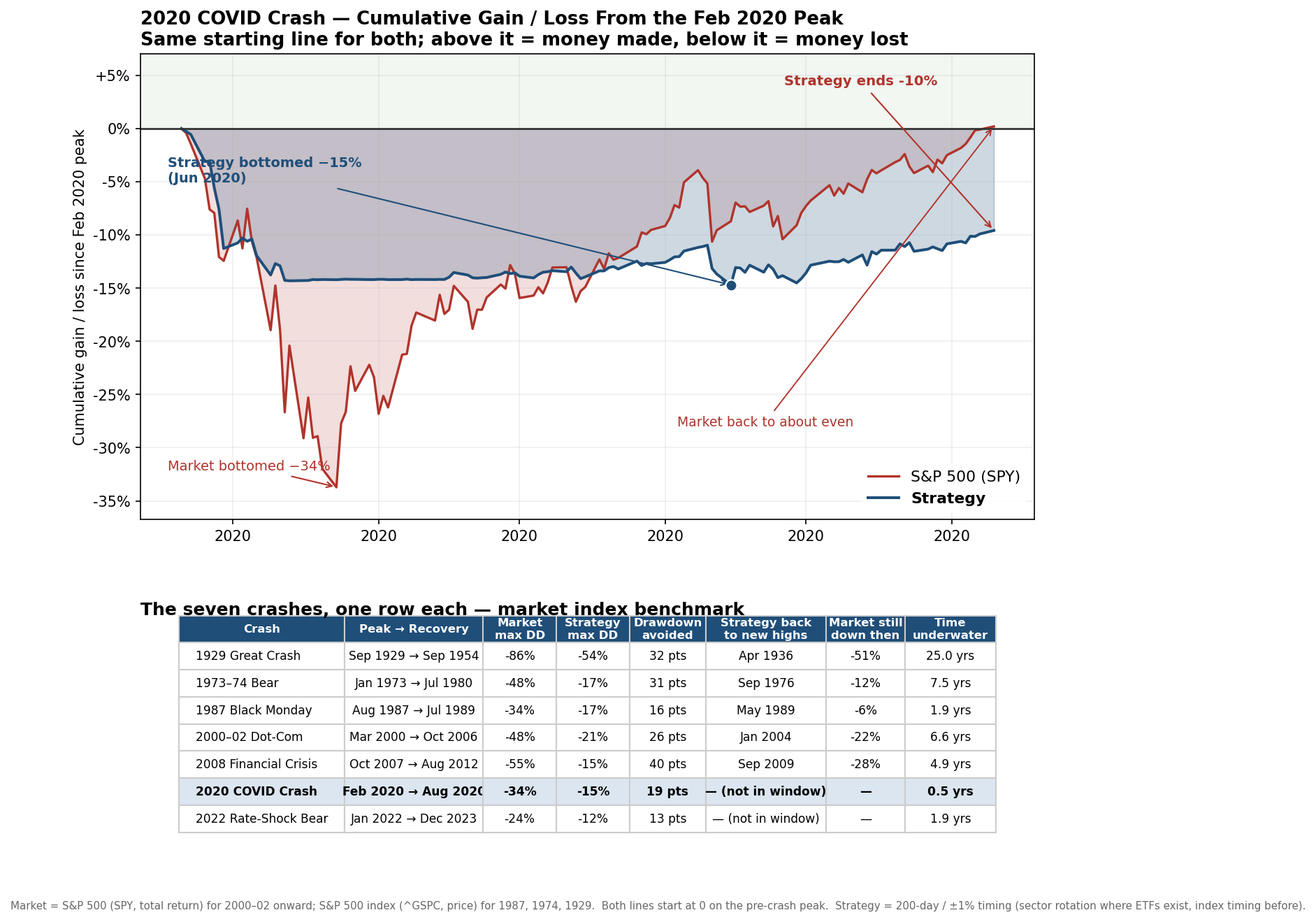
The strategy cut the drawdown roughly in half. In a V-shaped crash that snaps back this fast, the value is safety on the way down, the rule gives up part of the rebound while the trend proves itself.
When the market broke and where the strategy stood
From the peak in February 2020 to the bottom, the S&P 500 fell about 34% in 33 days. The market was back to even by August 2020, the fastest round trip on record. Over that same stretch, the worst our strategy ever fell was about 15%: the strategy steps out of the market when the trend turns down, and waits in safe Treasury bills until the trend turns back up.
Remember that the strategy is many small strategies, one for each slice of the market, each stepping aside on its own. It walks to cash gradually and walks back in gradually. Treasury bills paid almost nothing in 2020, so time spent in cash barely moves the line at all.
There is a cost to this, and this crash shows it plainly. This was a fast crash, down hard and back up almost as quickly. Our strategy cut the drawdown roughly in half, which is real protection, but a careful approach that waits for the trend to prove itself gives up much of a snap-back that sharp. Over this short window it ended a touch in the red even as the market recovered. In a fast V-shaped fall, what you are buying is safety on the way down rather than extra return.