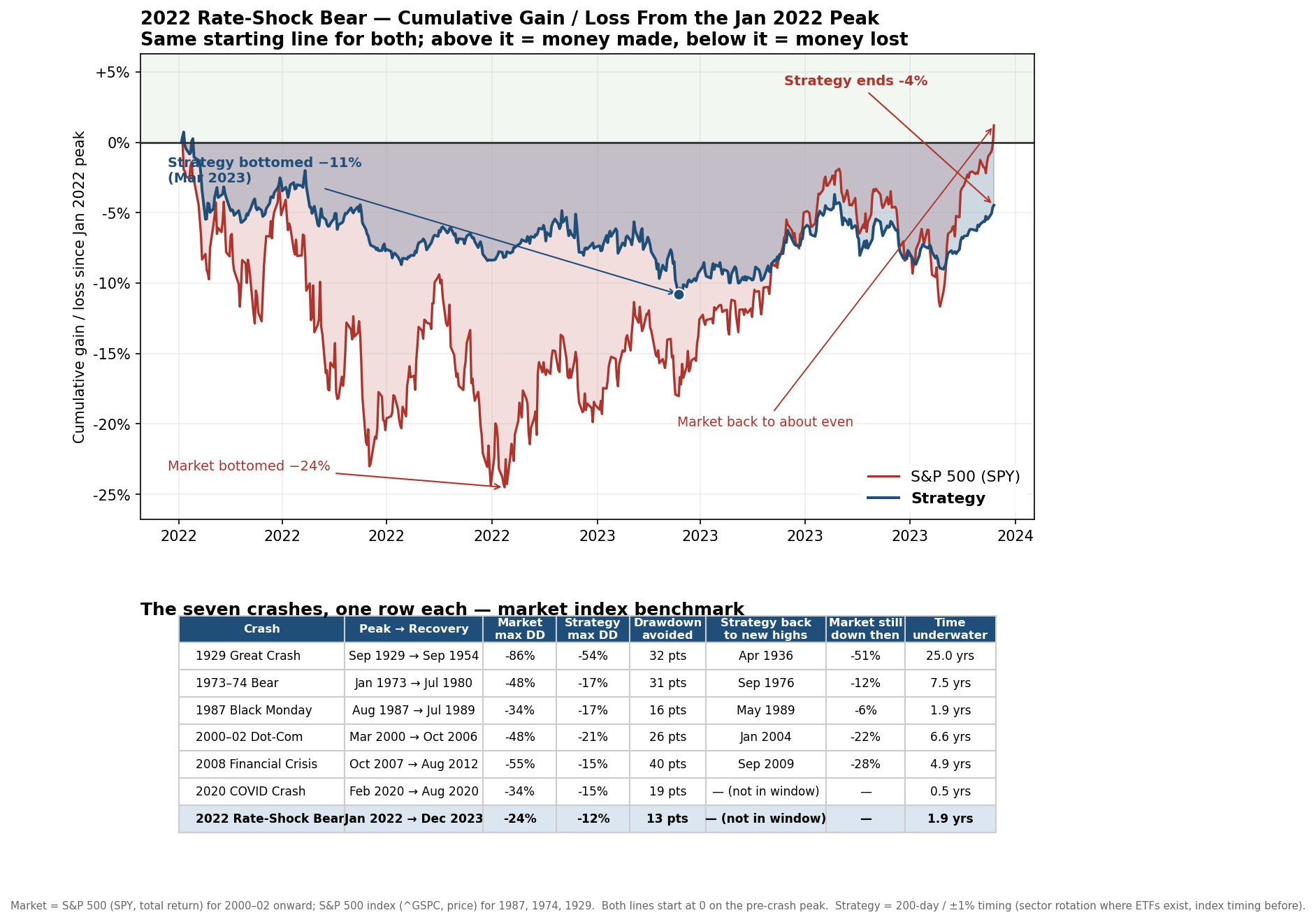
Half the pain of the market, while parked cash earned close to 5%. As in 2020, the caveat: a fast recovery means the rule gives back part of the rebound.
When the market broke and where the strategy stood
From the peak in January 2022 to the bottom, the S&P 500 fell about 24%. It then took until December 2023, roughly 2 years, just to get back to even. Over that same stretch, the worst our strategy ever fell was about 11%. Roughly half of the pain, for a simple reason: the strategy steps out of the market when the trend turns down, and waits in safe Treasury bills until the trend turns back up.
The strategy runs as many small strategies, one for each slice of the market, and each one steps aside on its own. It walks to cash gradually and walks back in gradually. By 2022 and 2023, Treasury bills were paying close to 5% again, so even sitting in cash the strategy was earning a real return, and its line drifts upward.
The same caveat that applied to the COVID crash applies here. This was a fast crash, down hard and back up almost as quickly. Our strategy cut the drawdown roughly in half, which is real protection, but a careful approach that waits for the trend to prove itself gives up much of a snap-back that sharp. Over this short window it ended a touch in the red even as the market recovered. When a fall is this quick, the rule earns its keep on the way down and gives some of it back on the way up.