If you have owned technology stocks over the past decade, you have had a wonderful run. The technology sector fund, XLK, compounded at about 23.9 percent a year over the last ten years. The S&P 500 did about 14.9 percent, and the equal weighted version of that same index did about 11.7 percent. In plain dollars, ten thousand dollars put into technology ten years ago became roughly eighty five thousand. The same ten thousand in the broad index became about forty thousand.
Technology has obviously been a good place to be, and everybody knows it. The more uncomfortable question is a different one. After a run like that, how much of your money is now sitting in one sector, and what happens if the landscape changes?
What you own without meaning to
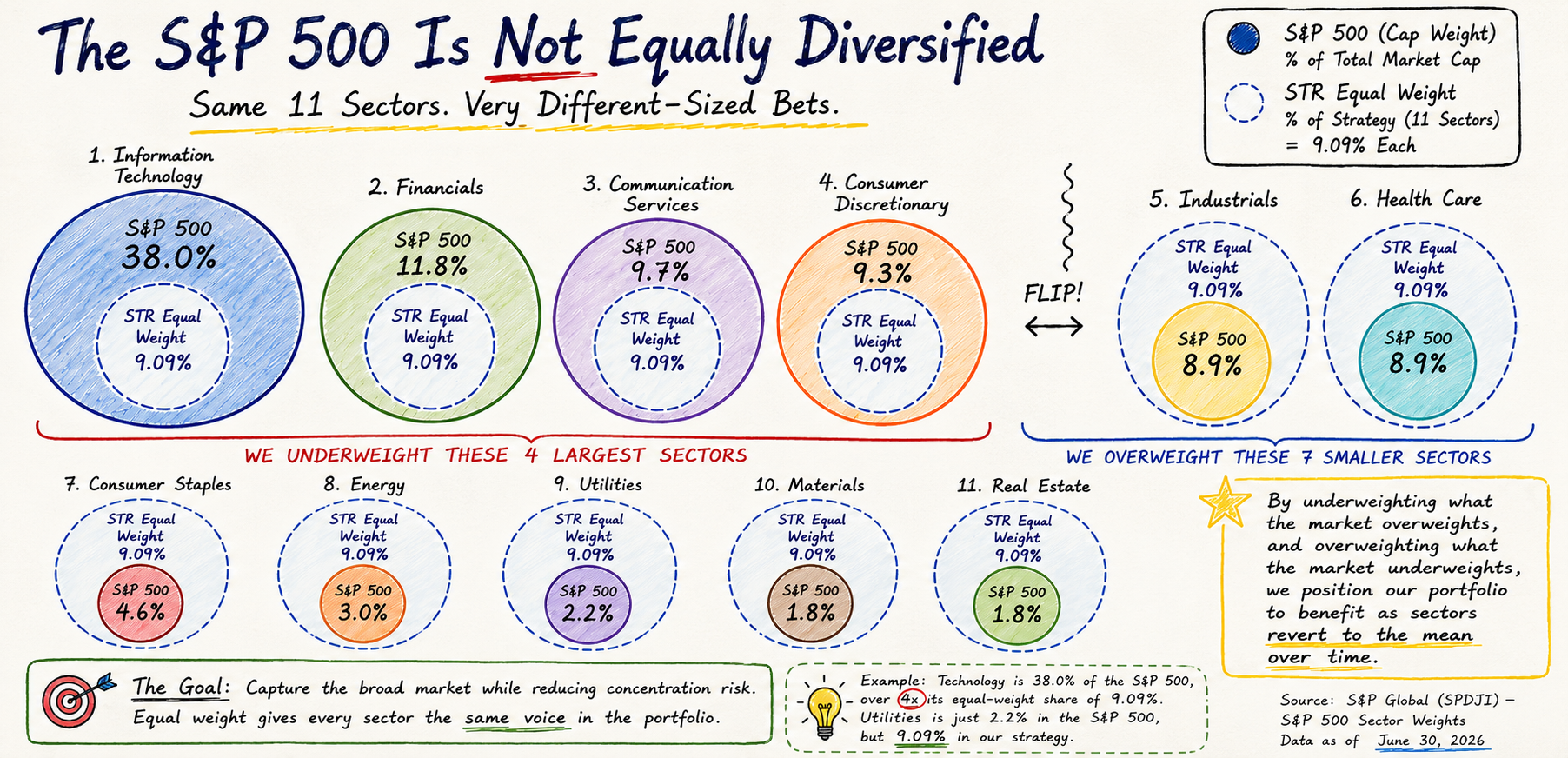
You do not have to own a single technology stock on purpose to be heavily invested in it. If you hold an S&P 500 index fund, and most of us do somewhere, the index has done the concentrating for you. As of June 30, 2026, technology alone was 38.0 percent of the S&P 500. The four biggest sectors together came to about 70 percent, leaving the other seven to split what was left.
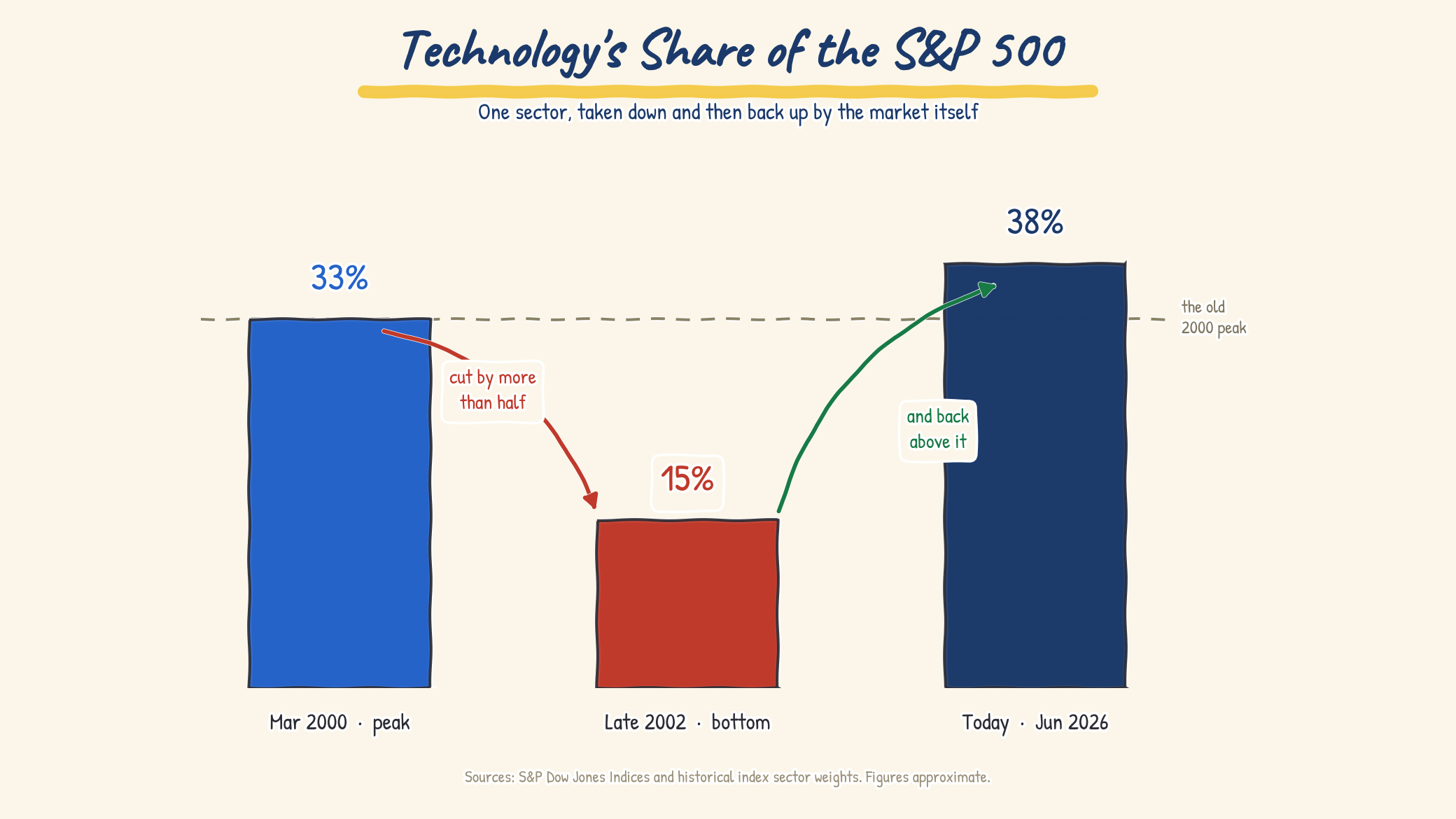
For perspective, at the top of the dot-com boom in March of 2000, technology was roughly a third of the index. Today it is larger than that. By late 2002 technology had shrunk to the mid-teens as a share of the S&P 500, less than half the share it had held two and a half years before. The sector simply fell far enough, for long enough, that the index quietly rewrote itself around the survivors.
A big weight is not a forecast, and I am not treating it as one. The companies behind today’s number are real and deeply profitable in a way most of the 1999 crop never was. But the number still says one plain thing. However this decade turns out, a great deal of it now rides on a single sector.
So the setup rhymes with 2000. I am not saying it ends the same way, the companies are sturdier now, but one sector carrying the whole index is exactly the case the discipline was built for. Two plain rules are the response.
Rule one, equal weight every sector
The first thing our strategy does about this is almost boring. It gives all eleven sectors the same weight, 9.09 percent each, and rebalances back to that every month. Technology gets the same share as utilities, the same as materials. That is roughly a quarter of the exposure the index gives it.
What that buys you is proportion rather than a prediction. If technology keeps leading, you still own a full slice of it and you still make money, just less than the index does. If leadership rotates the way it has rotated in every prior era, you are not the one holding four times too much of yesterday’s champion. Our note on whether one sector ever owns the future forever walks through a century of that evidence, and our note on equal weight versus cap weight shows what the weighting decision alone has been worth over a hundred years.
Rule two, stepping aside when a sector rolls over
Owning a smaller slice helps, but it does not help nearly enough if the slice you own falls seventy or eighty percent. That is what the second rule is for. Each sector is measured against its own 200-day moving average every single day, and when a sector breaks down through the band, that sector’s money moves to cash and waits. Technology is not special here, it gets the same rule as everyone else.
I ran the rule on the technology sector fund by itself, isolated from everything else, to see what it actually did. Over more than twenty seven years, the 200-day rule on XLK alone kept pace with owning the sector outright, about 10.0 percent a year against 10.2 percent, once the idle cash earns ordinary Treasury-bill interest, while cutting the worst peak-to-trough fall from eighty two percent to the mid-forties. In the dot-com bust itself, the rule sold five months after the March 2000 peak and sat out most of the collapse. I walk through that case in full, entry, exit, and the six whipsaws along the way, in a separate note: Surviving the Dot-Com Bust.
Where the rule costs you
I have no idea whether technology is about to fall, and neither does anyone else. I will tell you plainly what the rule costs. In the spring and summer of 2000 it flipped out and back in several times before the exit that finally stuck, and each false alarm cost a little. In 2020 it sold near the bottom of a fast decline and missed part of a quick recovery, finishing behind. Over the last ten years, giving technology only a 9.09 percent weight has cost real money against the index, and I would rather say that plainly than dress it up.
What the rules are actually for is the other kind of market, the slow one, where a leading sector rolls over and keeps rolling for two years. That is the market that ruins retirements, and it is the one no amount of conviction gets you through comfortably.
The bottom line
If you have done well in technology and you are wondering whether the sector has gotten ahead of itself, the useful move is to stop guessing. Start by finding out how much technology you actually own, counting your index funds carefully, because most people own far more of it than they think they do. Then decide whether you want that much riding on one outcome. Our answer is a plain one that we publish every week: an equal weight for every sector and no more, and a rule that quietly steps aside when a sector breaks down. It will not catch the top and it never claimed to. It is built so that no single sector decides how your decade turns out.
John